



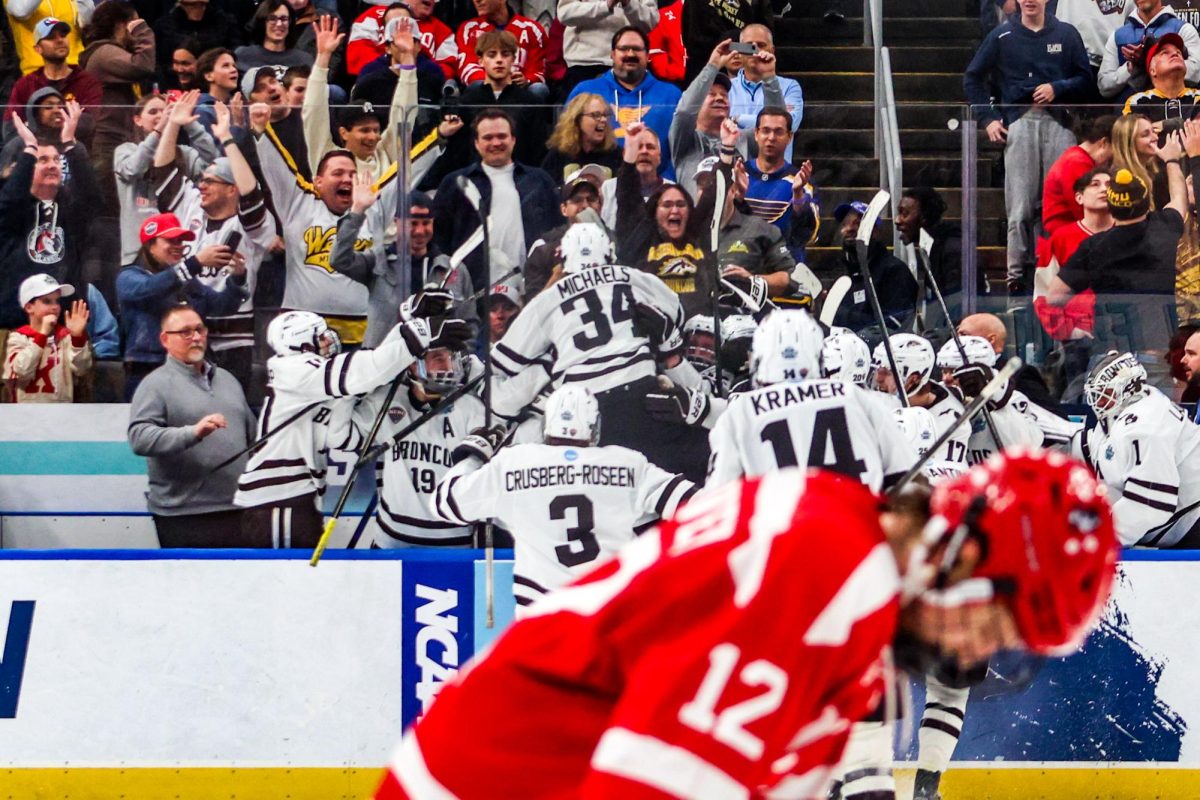


The Boston University women’s hockey team deserved to win the Beanpot on Tuesday night. That part is undeniable. It’d be nearly impossible not to deserve it with the shots-on-goal advantage (47-15) and ice tilt the Terriers enjoyed against Harvard.
BU’s head coach knows this. It’s why Tara Watchorn was so upset in her postgame presser after her team’s stunning 2-1 overtime defeat.
“For me personally, and the response I felt — probably the most frustrated [I’ve been],” she said Thursday in her midweek media call. “Because it is that 1 in 100 game.”
Then again, the Terriers put themselves in position to suffer an undeserved defeat. A costly overtime turnover, a 1-for-7 power play and a host of subtle mistakes in regulation led to the unthinkable. And BU is to blame for that.
Watchorn knows this too. She was uncharacteristically critical of her team’s performance postgame, but not because her frustration got the best of her. After two days to process it all, Watchorn held firm.
“Both are true. You can be frustrated with the way the game played out, knowing that, in a lot of ways, you did earn it,” Watchorn said Thursday. “But also you can look internally and say we could’ve done things to control the game a lot more.”
Folks rightfully took aim at the Terriers’ power play, which was given a comical amount of opportunity but failed to win the game (after equalizing on its first appearance). That BU’s skater advantage has been so bad its percentage actually improved after a 1-for-7 night doesn’t help. But when asked for the things the Terriers did wrong, Watchorn took a while to get to special teams. Indeed, BU didn’t play as well as the shot count indicates. For as dominant as star Harvard goalie Ainsley Tuffy (.955 save percentage, second in the country) was, the Terriers didn’t exactly force her to stand on her head.
Tuffy deservedly won Beanpot MVP. But to blame BU’s loss on the misfortune of facing a red hot goalie? Not for Watchorn.
“5-on-5 hockey? We weren’t that great,” she said. “We just didn’t sustain the way we normally would. Taking a shot at the end of your shift and changing versus holding on to it and stacking that shift — there was a lot we could’ve done to upgrade [the shot] and avoid those moments.”
Sounds crazy, that a team with a 47-15 SOG advantage didn’t sustain possession. But Watchorn values possession more than anything. It’s what BU’s entire system is built upon. If her team used it well, Watchorn would say it, like she did last season after the Beanpot semifinal against Harvard, in which the numbers were similar and BU very nearly lost. But this was not that.
Watchorn hates low-danger shots on goal, and BU put a ton of them on Tuffy. That’s another layer to this — the Terriers can’t cry woe is me at the opposing goalie’s performance, because they arguably helped her out. If BU didn’t settle for so many savable shots early, would Tuffy have been as hot as she was in the third period, which Watchorn said was BU’s best?
“Getting that flow is great,” Tuffy said postgame. “You just got to lock in on the first couple and then build off every shot.”

It was actually BU junior Mari Pietersen, who saw just 15 shots on goal, who was forced to make the tougher saves. She made them without the rhythm Tuffy was given, to her credit, but was put in a brutal position in overtime, asked to make a game-saving stop against a penalty shot after making only two saves in the third period. Crimson freshman Carla McSweeney buried it low glove side without a deke.
“I don’t think we did create the Grade As,” Watchorn said. “I think we warmed [Tuffy] up, too, and for a goalie that good, your initial shots on net you don’t want to be warm-up shots, versus what Mari had to face as her first shot [a Grade A, which Harvard scored].”
This is why Watchorn preaches upgrading to high-danger looks as much as she does. It’s the system, after all, and like it or not, BU didn’t adhere to it as much as it could.
And that, even though they should’ve won, is the reason the Terriers lost.
“We talk about that stuff a lot,” Watchorn said. “And it’s being able to buy into the game plan on the big stage.”
A closer look at BU’s overtime turnover
It was, ultimately, the same problem BU had at even strength that doomed it in 3-on-3 overtime. The Terriers settled for an inopportune look and paid the price.
For a team that prizes possession as much as it does, BU is skating on thin ice whenever it reaches the extra frame. 3-on-3 play often ends on a turnover and an odd-skater rush. In many ways, Harvard was on the front foot by playing on the back foot — all it needed was a turnover or an unfortunate bounce to create the game-winning chance, and it was on BU, which controlled possession for the entire frame, to prevent them.
Sydney Healey’s one-timer from the low circle felt like a great chance. But with no one back to collect the rebound (Keira Healey was below the goal line, and Kaileigh Quigg was crashing the net), should BU’s leading-scorer have let it rip?
“You’ve got to be thinking about where you’re at in your shift when you’re taking your shot,” Watchorn said of 3-on-3 OT. “And that every shot is a 50-50 puck.”
Quigg’s screen felt like a productive play. It certainly would’ve been at 5-on-5. But with only three players on the ice, should Quigg really have been there when she could’ve stayed high to collect a potential rebound?
“Something that we haven’t really dove into: Do you really need a net-front presence? In 3v3, how many times are you taking a shot from that far out that you need a screen? So I think your spacing can be even more intentional,” Watchorn said.
McSweeney easily skated onto the rebound and into a breakaway. Keira Healey caught her and took the penalty that led to the game-winner. Sydney Healey and Quigg made subtle mistakes, sure, and BU was previously undefeated in games that reached overtime (all three went to shootouts), but as it pertains to the game-ending play, the Terriers can again find ways to blame themselves.
“Our team last year, we just got there with our maturity and understanding way earlier,” Watchorn said. “But we’re talking about college-age players. We’re adding a lot of maturity to their games, and you can only give them so much.”

Scouting Vermont
Suddenly on a two-game losing streak, the Terriers host Vermont for a two-game series on Friday and Saturday.
BU knows UVM well. It faced the Catamounts four times after the New Year last season, including in a 4-3 overtime victory in the Hockey East quarterfinal. The Terriers went 2-1 in the regular season.
The scout on those Cats was well-known. They played on the rush. They gave you plenty of offensive zone time but made you pay for mistakes. Jim Plumer’s team was only 9-25-2 last season and was terrible in most statistical categories, but it was also a tough out for nearly every top Hockey East team.
This year? The Cats haven’t played top-tier competition as tough, but their record (10-12-4, 4-7-3) and numbers are much better.
“They’re unpredictable over the years,” Watchorn said. “We found some tendencies last year as we played them a lot in the back half of the season. They play off the rush, they’re opportunistic. Though I do feel like they’ve had way more intention [this season] of strategies in the offensive zone to sustain as well.”