





All Kaileigh Quigg and Luisa and Lilli Welcke could do was laugh.
Which was a pretty good summation of where the Boston University women’s hockey team’s power play was at. Because at this point, with BU’s power play sitting at second-worst in the country, about to hit two months without scoring? The Terriers’ struggles had gotten pretty comical.
And so, informed after practice Monday that their assistant coach was “losing her mind” watching the power play from the bench during Saturday’s victory at New Hampshire, Quigg and the Welckes just giggled. Not at the sheer toothlessness of their special teams, though. At their complete inability to bury the chances they were creating.
Quigg, who found a wide-open one-timer from the doorstep against the Wildcats but blasted it past a vacated net, knew her blunder was exhibit A.
“Should’ve had one against UNH,” she said, laughing and scratching her head. “Sorry boys.”
Entering Tuesday’s Beanpot semifinal against Northeastern, BU’s power play was an astounding 3 for 66. It had last lit the lamp at Conte Forum against BC on Nov. 13. Incredibly, the Terriers had scored more goals on the penalty kill (four) than on the skater advantage. In some places, that’d be grounds for hysteria, and head coach Tara Watchorn has answered her fair share of questions about the starving PP.
But her players’ reaction told you something: the Terriers knew they were close to a breakthrough.
“We just need one,” senior Lilli Welcke said.
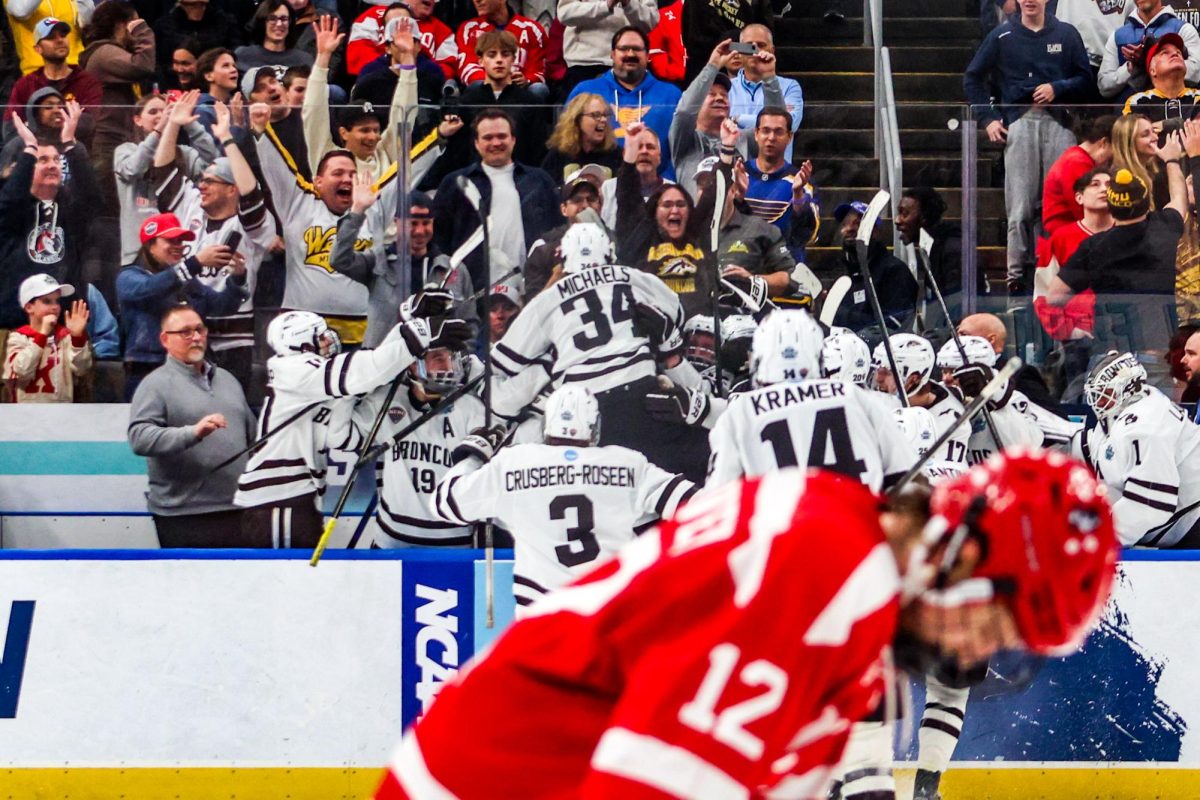
Well, they’ve got it now, and what a moment they picked. On a 4-on-3 advantage in overtime at Walter Brown Arena late Tuesday night, senior captain Maeve Carey buried the No. 7 Huskies with a wrister from the high slot. Somehow, it was the defender’s first point of the entire season, and it came against Northeastern’s fourth-ranked kill (88.7 percent). The record crowd of 2,281 erupted.
“Just kind of let it rip,” said Carey, who noted the effective net-front screen from Quigg and the presence of star senior Sydney Healey, who was positioned for a rebound below the right circle.

No doubt, it was far from the Grade A-plus chance the Terriers would ideally create on the power play. Still, if you listen to Watchorn, what Carey saw is exactly the look BU is trying to create — traffic in front of the goalie with a clear rebound opportunity, what Watchorn likes to refer to as a “goalieproof” chance. Even if Carey’s shot was saved — and with NU’s Lisa Jönsson in net, it would’ve been nine times out of 10 — Healey, BU’s best scorer, was there to clean up the scraps. It’s the kind of conflict an offense with an extra skater is trying to put defenses in.
While it’s understandable to clammer for a struggling PP to shoot more, Watchorn has resisted that notion and preached patience. She calls the process “upgrading the puck.” BU is not looking to pepper opponents with low-danger chances — it doesn’t have the personnel for effective one-timers and shots from the point anyway — and is instead looking to generate as quality of a look as it can, which usually means waiting for BU sweaters to crowd the crease in dangerous areas.
“When you look at having an extra player, how do you upgrade the puck enough that you have an extra body down there?” Watchorn said last Thursday on her midweek media call. “A commitment to being at the net, bearing rebounds and having screens is going to help us.”
It can be a maddening philosophy, especially when the goals dry up like they have. But Watchorn has remained steadfast in her process, probably because the alternative would be even worse — even NHL teams are steering away from one-timers and shots from the point on the power play (and they have the numbers to support it), and Watchorn is well aware the math likely leans further from those types of looks in women’s college hockey.
“At the end of the day, shots from far out, without screens and upgrades and making it difficult for the goalie — especially women’s hockey, where our shots are a little behind what an NHL stat would be — I’d like to think there’s some truth to that for sure,” said Watchorn of the PP evolution in the pros.
Shots from the point, given BU’s tendency to miss the net, also make it harder for the Terriers to sustain possession and offensive-zone pressure, which Watchorn values so highly on the PP or at even strength. BU is far more likely to recover rebounds on shots closer to the goal. While the first purpose of the PP is obviously to score, maintaining territory on the skater advantage is a priority not lost on the Terriers.
“Even when we don’t score, we’ve gotten a lot of momentum off our power play with the following shifts,” Carey said.
Besides, Watchorn and assistant coach Megan Meyers have insisted the PP is moving in the right direction. They claim it has looked great in practice, and Meyers, even if clearly frustrated by the lack of goals, felt BU generated good looks in the win at UNH. For as brutal as Quigg’s miss was, the spin zone is that the Terriers would much rather that opportunity be missed than not exist at all.
“At this point, you can’t really focus on the numbers,” said senior Luisa Welcke. “All we can do is look forward. We’ve had some really good chances in the last couple games, and we’re just gonna focus on what we can do better and go from there.”
The snake bite, for now, is gone. Now we wait to see if BU indeed just needed one.